Deontological Thinking
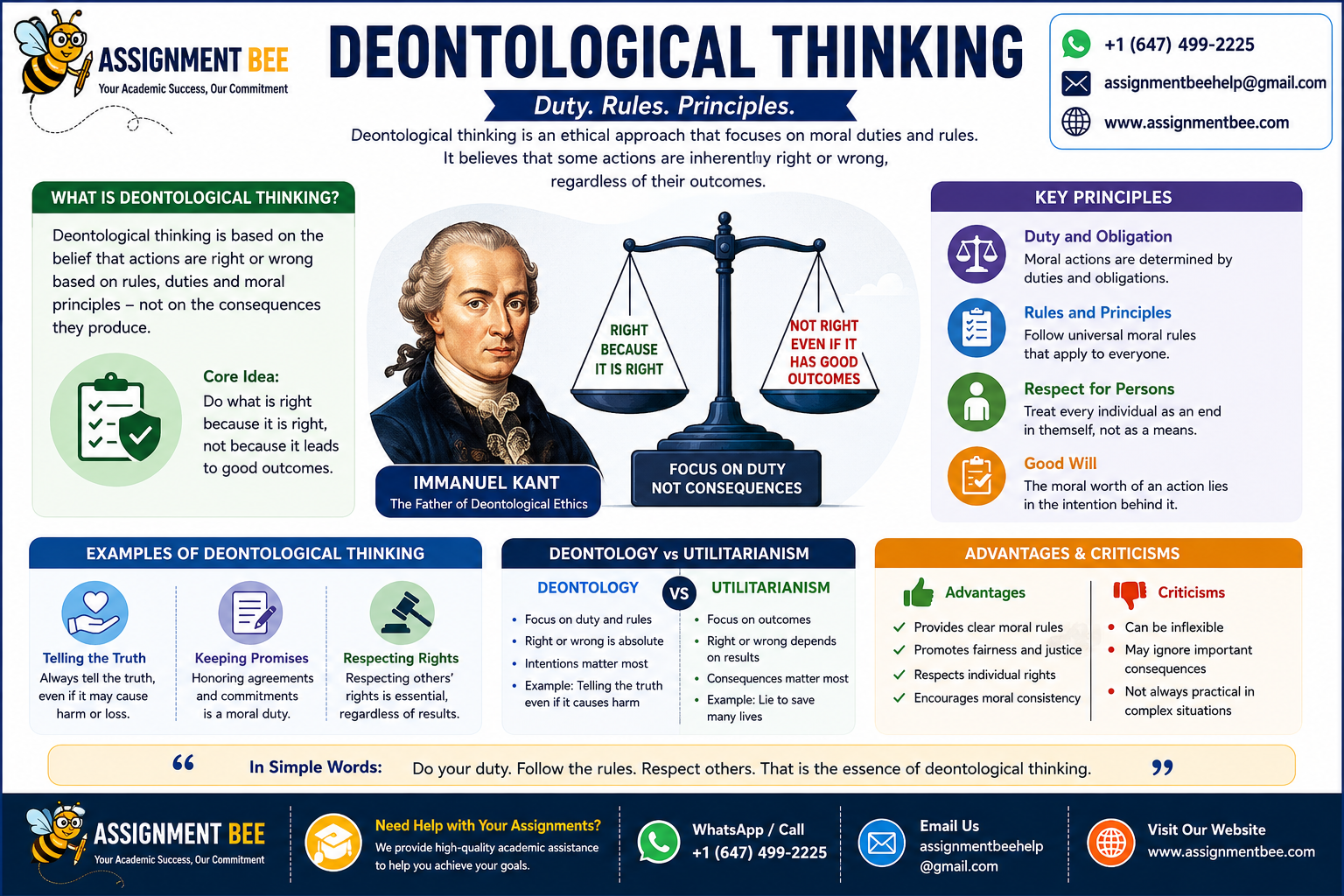
Learn how deontological thinking focuses on moral duties, universal principles, and ethical obligations. This infographic highlights key concepts, practical examples, advantages, and criticisms of deontological ethics.
What Is Deontological Thinking?
Deontological thinking is considered an ethical theory which helps in evaluating actions in terms of the moral duties, obligations and principles, instead of associated consequences. The deontological theory is primarily formulated by Immanuel Kant, whose works focused on moral duties and universal ethical principles (Ramaswamy, 2018). This theory helps to understand that moral behaviour needs to be guided in accordance with the universal rules that are equally applicable to all individuals. In contrast to utilitarianism, which is focused on only outcomes, deontology is aimed towards inherent morality associated with actions (Conway and Gawronski, 2013).
Key Principles of Deontological Thinking
In addition to this, an important notion in deontological ethics is Kant’s principle, highlighting that individuals need to adhere to moral rules which are applicable on a generalised basis for everyone. This principle reflects that individuals need to follow specific types of rules that they believe can be followed by everyone (Xu and Ma, 2016). In other words, it can be understood that prior to taking any action, any individual should ask whether this action would be acceptable if everyone started to behave in a similar manner. Moreover, it is obtained that if universal adoption of a specific action would lead to contradictions or undermine society, then the undertaken action can be considered morally wrong (Gawronski and Beer, 2017).
In addition to this, deontological thinking puts a strong focus on preserving human dignity and respect for individuals. Further, Kant also argued that individuals should never be treated just as a tool to attain an objective, but they should always be considered as ends in themselves. This principle has strongly affected the contemporary human rights-based frameworks, legal systems and professional ethics (Dierksmeier, 2013). For instance, healthcare professionals expect to respect the confidentiality of patients not because doing so may result in the best outcomes, but because offering respect for privacy is regarded as a moral duty (Olorunfemi et al., 2024).
In this direction, one of the main strengths of deontological ethics is its commitment towards fairness and consistency. The application of the same moral rules for every individual, it helps safeguard the individuals from exploitation and discrimination. Further, this approach provides clear ethical guidance in specific situations where outcomes tend to be uncertain or complex to predict (Kumar, Sharma and Singh, 2025).
Criticisms and Limitations
However, the deontological thinking also puts certain limitations. Sometimes, it can be problematic to decide what is the right action in the case when different moral duties tend to conflict with each other (Conway and Gawronski, 2013). For example, telling the truth may lead to harm in specific circumstances. However, withholding information could result in a violation of the duty of honesty. Moreover, critics also argue that deontology is not always effective for providing practical solutions for resolving conflicts (Balica, 2017).
Advantages of Deontological Ethics
Despite the above challenges, deontological ethics is considered one of the highly influential ethical frameworks adopted in both philosophy and professional practice. The main focus of deontological ethics is on duty, respect, and moral consistency, which continues to determine ethical decision-making across healthcare, law, education, and public administration (Ulum, 2025). Moreover, understanding deontological thinking also offers a valuable perspective regarding the importance of principles as well as integrity in ethical behaviour.