Harvard Referencing Guide
What Is Harvard Referencing?
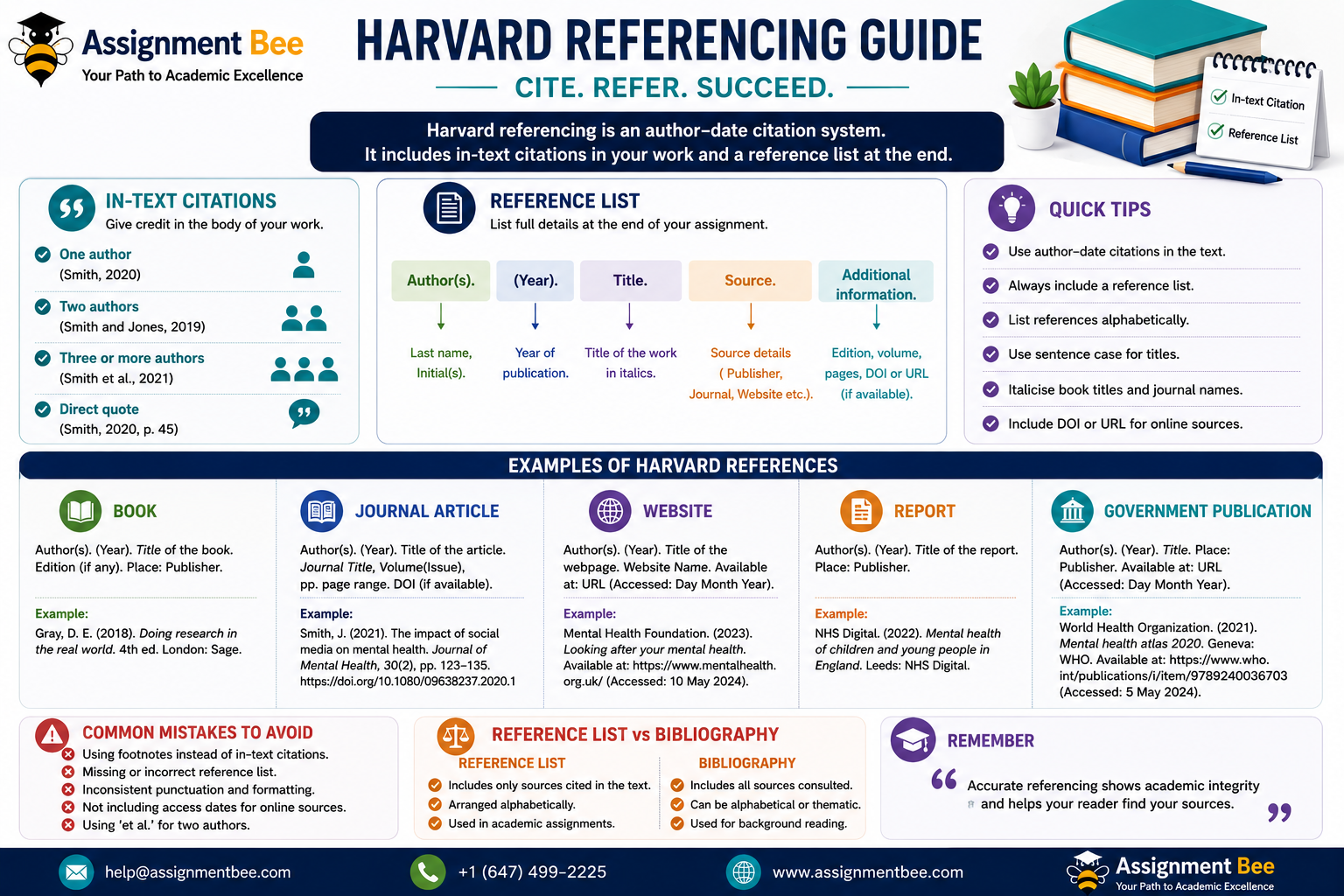
Harvard referencing is regarded as one of the most commonly applied styles of citation in universities around the world. It is highly used for referencing sources in studies from nursing, business, psychology and social science domains because this referencing style also provides a clear and organised method to acknowledge the sources. In addition to this, proper referencing is also important in academic writing because it helps to highlight research skills and enables the formation of arguments with evidence. Moreover, referencing style helps in avoiding plagiarism.
Harvard In-Text Citations Explained
Furthermore, the Harvard referencing system involves two key elements: firstly, the in-text citations and secondly, the reference list. In-text citations are provided in the body of the assignment when information, ideas, and quotes from another author or source are used. Moreover, the citations mainly comprise the author’s surname and year of publication. For instance, mental health stigma can negatively influence the treatment-related outcomes (Neville, 2016).
In addition, if a direct quotation is applied, a page number should also be included. For example, “Stigma results in declined self-esteem and self-efficacy” (Corrigan, 2004, p. 617).
Moreover, accurate page referencing is also significant because it helps the readers to locate the original source in an easy way.
How to Create a Harvard Reference List
At the end of this assignment, all the cited sources need to appear in the reference list. References need to be arranged in alphabetical order, beginning with the surname of the author. A typical book reference done in Harvard style involves the author, year of publication, title, place of publication, edition, and publisher details. For example:
Cottrell, S. 2019. The Study Skills Handbook. 5th edn. London: Red Globe Press.
Harvard Referencing for Journal Articles
Moreover, the reference for a journal article requires mentioning additional details like the title of the journal, volume number, issue number, as well as page range. For instance:
Corrigan, P.W. 2004. How stigma interferes with mental health care. American Psychologist 59(7), pp. 614–625.
Harvard Referencing for Websites
Further, the Harvard referencing style also allows citing websites. The website referencing involves mentioning the author or organisation, publication year, title of the webpage, website name, URL, and date of accessing the source for verification purposes. For example:
University of Oxford. 2026. Harvard Referencing Guidelines [Online]. Available at: https://oxford.ac.uk (Accessed on: 29th May 2026).
Harvard Referencing Tips for Students
Consistency is regarded as one of the most important elements of the Harvard referencing style. Students are required to maintain consistency in the formatting style throughout the assignment. Several universities also follow their own guidelines for Harvard referencing, so it is important to verify and ensure that the institutional requirements are met in a careful manner.
Moreover, students often make certain mistakes like missing the page numbers, following an inconsistent formatting, and providing incomplete references. Using reference management software like Mendeley, Zotero, or EndNote can help to enhance accuracy and organisation.
Furthermore, referencing also improves academic integrity by giving respect to original authors and intellectual property. In the views of Panjaitan, Novelyn and Angreni (2024), proper citation is important for ethical academic writing.
Hence, it is a significant academic skill that helps support credibility, transparency, and professionalism while completing university assignments. Mastering the correct techniques of citation can significantly enhance the quality and reliability of the presented academic work.