Principles of Human Rights: Meaning, Importance and Key Examples
What Are Human Rights?
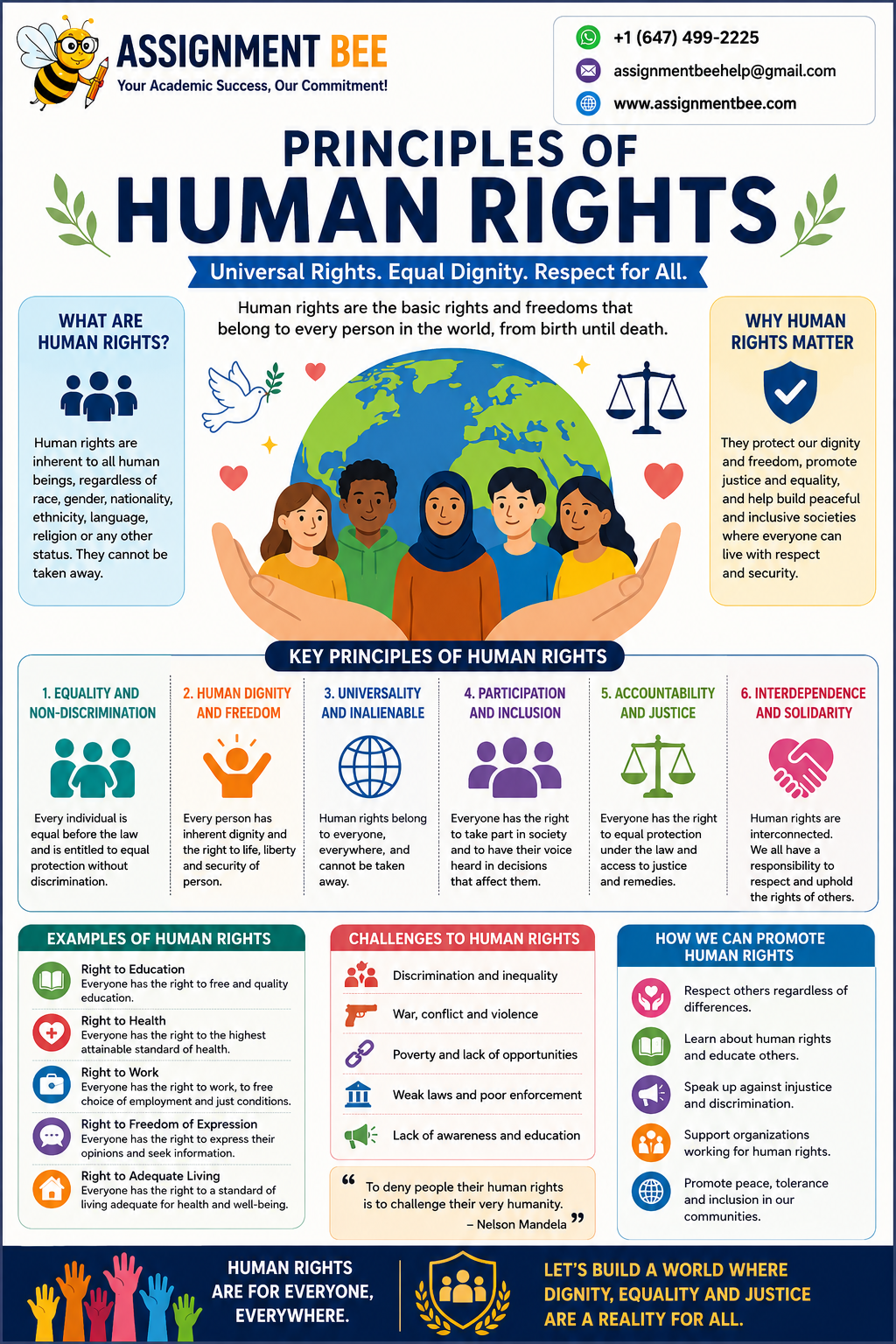
Human rights can be understood as the basic rights and freedoms that are provided to every individual merely because they are human. These rights are applicable to all irrespective of religion, nationality, gender, age, ethnicity, or a diverse social background. The principle related to human rights is reliant on the idea that every individual is equal in terms of dignity and that every individual deserves equal treatment with respect and fairness (Donnelly, 2019).
The modern human rights framework is strongly affected by the Universal Declaration of Human Rights (UDHR), which was implemented under the United Nations in 1948. The declaration was generated after the Second World War for the promotion of peace, equality, and justice across the globe. UDHR describes a diversified range of rights and freedoms which need to be protected for people. These involve the right to freedom of expression, life, work, education and safety from discrimination (Alfredsson and Eide, 2023).
Human rights need to be integrated into diverse categories. Civil and political rights help in safeguarding individual freedom, such as freedom of speech, religion, as well as their rights for participating in governmental activities. Further, economic and social rights emphasise the basic living conditions, like access towards healthcare, housing, education and employment. In addition, these rights support both personal freedom and well-being (Talbott, 2010).
Why Human Rights Matter?
In addition, the main feature of human rights is that they are considered universal. This means that each individual has the same rights irrespective of their living and background. In addition to this, human rights are also interrelated. For instance, access towards education can also enhance employment opportunities. However, good healthcare can also contribute towards assisting individuals in leading a healthier and more productive life. When one right is denied, it can influence the benefits associated with other rights (World Health Organization, 2010).
Human rights are identified to play an important part for governments, organisations, as well as businesses. Under human rights, governmental bodies understand the responsibility to safeguard citizens from discrimination as well as abuse. Further, organisations are also required to design fair policies and inclusive settings. Apart from this, the businesses are fostered for respecting the human rights throughout their operations as well as their supply chains. Giving respect to human rights also helps in building trust, fairness, and social stability (Sullivan and Robinson, 2017).
Challenges to Human Rights Protection
Despite the prevalence of international agreements and legal protections, human rights-related challenges are identified to exist in several regions across the globe. Challenges like poverty, discrimination, inequality, and restricted access towards education continue to influence millions of individuals. As an outcome of this, international organisations as well as governments start to work on improving the safeguarding of human rights and promoting equal treatment for all (Cole, 2022).
Thus, it can be concluded that the principle of human rights is helpful for understanding the value and dignity of individuals. By safeguarding fundamental freedoms and enabling equality, human rights contribute towards the creation of fairer societies as well as enable human development across the globe.